



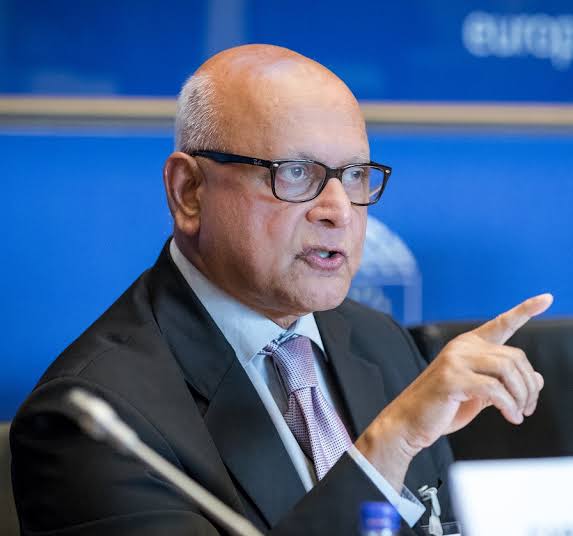
Says Jay Mitra, professor of Business Enterprise and Innovation and Head, School of Entrepreneurship and Innovation, University of Essex, UK, in an encounter with SIAKA MOMOH in Abuja, in July 2008.
This interview is being republished here, as one of our evergreen series (remains as relevant as ever) which this weekly magazine will dish out to you from time to time. It was originally published in BusinessDay about two decades ago.
Cerebral Jay Mitra will make your day. Sure. Take him on, on the subject of entrepreneurship; you will get what I mean. A chat with him will give you a clear picture of what entrepreneurship is, and what it is not. About two years ago, he was asked to set up University of Essex’s School of Entrepreneurship and Innovation which, according to him, “is the first and most unique centre or school of its kind in the UK, if not the entire Europe” because of its concentration in entrepreneurship innovation and business at the same time.
Mitra believes he is heading a unique school in the UK and says “our machine is a global machine, an international machine to work with partners and institutions from across the world”. The school has significant interests in some different parts of the world. Mitra is in Nigeria in search of considerable prospects for mutual cooperation and knowledge sharing and development between his institution and Nigerian institutions, and hopefully also, between UK and Nigeria.
Entrepreneurship not new
His comment about his starting a school of entrepreneurship at University of Essex some two and half years ago suggests that entrepreneurship is new in the UK. Jay Mistra disagrees. Says he: “Entrepreneurship in the UK is not that new. It’s been nearly two decades now. But what has been happening until now is that most universities in the UK have merely set up entrepreneurship research centres or training centres or indeed some new courses in entrepreneurship as part of existing programmes.”
For him, the University of Essex programme is different because it is an entirely new school dedicated to the study of entrepreneurship and innovation, research, postgraduate and undergraduate teaching, working with businesses outreach and development in the community, says Mitra. For Mitra, it is new to have all that in one institution – as part of an academic department.
Jay Mitra notes entrepreneurship is being promoted in a way that “it is looking at considerable sort of prospects”. What is important, for him, is that the need to make new products, the need to provide new services, the need to change organisations, how organisations grow up strategies, behaviour, practice, has become such an important phenomenon facing an important consideration in all economies around the world that if you do not study that phenomenon properly, if you do not research properly into that phenomenon, then of course, it passes you by because you do not understand it. He explains that is the reason why entrepreneurship education has become so important to economic generation.
Funding
Mistra says by and large, the University of Essex entrepreneurship school is funded through the market place, that the school gets government money for students at the undergraduate level. “The rest of the money is drawn from money drawn from fees collected especially from students at the postgraduate level; and funding for research can come from the private sector as well as from the European Union or indeed from the Research Council in the UK. But primarily, funding for projects on entrepreneurship tend to be funded from the private sector and from government,” he says.
Target
Jay Mitra will not want anybody to think his school is on a drive to draw Nigerian students to Europe. He says the primary target is not to what extent those doing business in Africa can get connected with the UK; to what extent Nigerian students , whether they go to the UK or not, can interact with UK students so that they themselves can become the new ambassadors of entrepreneurship in the future. “If as part of that we find that Nigerian students will be interested in studying in the UK in our school, etc, that is fine,” he says.
He holds it is also the University of Essex’s interest to see how it can support and work with universities here to develop entrepreneurship centres with centres of entrepreneurship activities and entrepreneurship research in Nigeria. Mitra is very pleased with what is happening with the National Universities Commission about the promotion of entrepreneurship and he thinks it is wonderful. He has had some preliminary discussions with them and believes “if we can develop and work with the universities here too, then that to me is much more of a target than just recruiting Nigerian students to come to the UK”.
Entrepreneurship’s contribution to growth
He explains entrepreneurship is regarded by economists since Alfred Marshall and most notably, Joseph Schumpeter as the most significant contributor to economic growth. He says previously, economists did not want to regard entrepreneurship as important because they could not measure it, because they could not understand why, even after you took care of land, labour and financial factor, what was the added ingredient; they could not explain why economic growth took place the way that it did.
“And eventually, they came round to the conclusion that it was new innovation and new business creation that really contributed to economic growth not simply just developing more and more of the same thing but continually asking the question on how you change the way you do things and how you add value.”
He argues entrepreneurship primary purpose is to create and add value to the economy. He tells you an economy does not simply grow by having more of the same thing. Why? “For the simple reasons that there is competition; and you have to be doing something different, you have to be generating some knew value in order to stay ahead of competition, but most importantly, value for the economy.”
He explains all the things that have been happening in our lives, every time we look at things that have been better in our lives some ten years ago. It has been as a result of entrepreneurial innovation goal.
Entrepreneurship in Nigeria
Nigeria, for him, represents, in many ways, the particular situations that many develop economies face. In his view, if entrepreneurship is to succeed, if it is to produce genuine good and benefits to the economy, the role of institutions becomes important. By institutions he means government institutions, educational institutions, policy, the role of the legislature, the role of the judiciary. He notes: “Not so much that these institutions work, but the institutions contribute to quality that they actually contribute to real change”.
Mistra says another more important element of institution has to do with “our substance, our norms, our behaviours, our practices”. “We cannot always rely on government to deliver all. We have to, in a sense, create our own social customs and ask questions from ourselves as to whether the way we interact with each other actually contribute to change or not for the wider community.”
Entrepreneurship and small business
If you think every small business person is an entrepreneur you are wrong. Mistra says it pointedly: “If small business is not about value creation it cannot be entrepreneurship. Small business creation is one thing – we have a new venture to make a new product, to make a new development. You cannot make new products or new services if you do not have a different mindset. It is not possible.” He explains: “As a small business creator (who is entrepreneurial) you have to think differently, you have to think out of the box, you have to think in terms of making a change which never existed before; you have to be in a position in which you take enormous risk about things which may or may not work in society – in the larger economy. In that sense, entrepreneurship is more than just creating small business.”
Very few people actually start small businesses; does that mean the rest of the society is not entrepreneurial? “Of course not”, he says, “we have entrepreneurial people in many shapes and sizes; you have in society for example what we call social entrepreneurs – people who are working within the community, people who are working with the rich or the poor, people who are working in the community to change the way they actually look at how their own lives are led; people who are working in larger organisations to change the way the organisations develop products, provide services and things of that nature.”
For him, you can have entrepreneurship in small creations, you can have it in large firms through innovations, you can have in society, in the wider community through social enterprises – enterprises that do not just look at the ways of making money or ways of profiting, but look at ways of adding value that can help better the lives of the community that they live in.
Jay Mitra gives three examples: Supporting children of the poor in school with meals – meals in school – this, he says, will serve as an incentive for them to go to school. With such an incentive, number of school drop-outs will drop and there will be less social problem, he says. Another is transportation for students. This, he says, is an incentive too. “With free transportation, students will be encouraged to go to school and this will have an effect similar to the meals example. The third example is cost of producing production of mosquito nets. “The cost of producing thousands and thousands of them is about the one day budget of the Pentagon in the U.S. ,” he says. For him it is not just a money issue, it requires money directed towards value creation.
Why? “Because by creating these mosquito nets you are actually stopping malaria from affecting people and if you are healthy people, you can live a healthy live and you can contribute to the economy. That too is entrepreneurial in the sense that we change the way we live our lives, not change for its sake.”

