WHO SPEAKS FOR NORTHERN NIGERIA? The US–Nigeria Minerals Pact and the Question of Northern Participation
The signing of the new Nigeria–United States mineral investment framework in New York should not be treated merely as another diplomatic ceremony. It raises a larger and more consequential question about who participates in shaping the future of Nigeria’s mineral economy—and who benefits when those resources are developed.
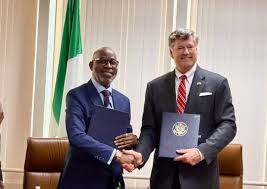
On September 23/24, 2026, Nigeria’s Minister of Solid Minerals Development, Dele Alake, and the United States Deputy Secretary of State, Christopher Landau, signed a framework designed to facilitate cooperation in geological exploration, mineral development and processing, infrastructure, technical capacity and investment. The Federal Government describes the country’s mineral-resource potential as worth about $700 billion.
Yet the official account of the signing lists Lagos State Governor Babajide Sanwo-Olu among those who witnessed the ceremony, alongside federal mining officials and representatives of the Nigerian Solid Minerals Development Fund and Nigeria Solid Minerals Company. No Northern state governor is listed among the witnesses.
That fact deserves public scrutiny.
This is not simply about who attended a ceremony
It would be misleading to argue that a Northern governor legally had to sign the agreement. Mineral resources and mining regulation are substantially matters of federal jurisdiction, and the agreement itself is a Federal Government–United States framework, not a state-level MOU.
But that does not end the question.
The more important question is:
> If substantial portions of Nigeria’s mineral wealth are located in Northern states, how will those states, their businesses and their communities participate in the implementation of the agreement?
That question becomes particularly important because the Federal Government itself says the framework will move beyond diplomacy into actual projects—identifying viable projects, mobilising investment and establishing commercial partnerships.
In other words, the signing may have happened in New York, but the consequences will eventually be felt on Nigerian soil—particularly in the communities where exploration and mining take place.
—
Northern Nigeria cannot afford to be a spectator
The Nigerian Geological Survey Agency’s own geological information demonstrates the scale of the country’s mineral potential.
Its official resources identify major opportunities involving gold, iron ore, limestone, coal, lead-zinc and other minerals. The Agency also maintains geological and mineral-resource maps covering states across Nigeria and specific corridor maps for commodities including gold, lithium, copper and rare earth elements.
Northern Nigeria is therefore not merely an observer of Nigeria’s mineral economy.
It is part of the resource base that could attract the very investment now being pursued internationally.
Nasarawa provides a particularly important example. The Geological Survey Agency’s state mineral-resource map identifies occurrences including tantalite, tin/cassiterite, lithium-related minerals, iron ore, lead-zinc, baryte, coal, limestone, gold and other commodities.
The Federal Government itself has also highlighted Nasarawa’s importance: in January 2026, the Solid Minerals Minister said a $600 million lithium-processing plant in Nasarawa State was ready for commissioning.
And this is not only about Nasarawa.
At a September 2026 briefing concerning Nigeria’s participation in the UN General Assembly, Nasarawa Governor Abdullahi Sule and Kebbi Governor Nasir Idris specifically said they were seeking international investment opportunities for their states, particularly in solid minerals. Governor Sule and Governor Idris were among Northern governors participating in the broader international investment discussions.
This demonstrates something important: Northern governors are already conscious of the investment potential of their mineral resources.
The question is whether that awareness will translate into a coordinated Northern strategy.
—
The real danger: exporting rocks and importing finished products
Nigeria has repeatedly confronted the problem of extracting natural resources without capturing enough value from processing and manufacturing.
The new US–Nigeria framework explicitly talks about avoiding this pattern.
Minister Alake stated at the signing that Nigeria does not want to remain merely a source of raw materials and wants stronger local processing, skills, quality jobs and opportunities for Nigerian businesses.
President Bola Tinubu similarly told the African Minerals Strategy Group in June 2026 that Africa must prevent its critical minerals from becoming merely raw materials for other countries and should promote beneficiation and value addition within Africa.
That principle must also be applied within Nigeria.
If lithium is mined in Nasarawa, gold in Zamfara or other minerals are developed in Northern communities, the economic objective should not simply be:
Mine → export → import finished products.
The objective should increasingly be:
Explore → mine → process → refine → manufacture → export finished or semi-finished products → create jobs and industrial capacity.
That is where Northern Nigeria needs to enter the conversation.
—
Where are the Northern industrialists?
This is perhaps the most important question.
International mining investment creates opportunities far beyond the mining pit.
There will be demand for:
geological services;
drilling companies;
laboratories;
mineral testing;
engineering;
heavy equipment maintenance;
transportation;
security services;
construction;
power generation;
water infrastructure;
logistics;
warehousing;
financial services;
mineral processing;
fabrication;
packaging;
technology;
environmental services;
professional consultancy;
industrial training.
If foreign companies arrive with their own capital, technology, equipment, contractors and supply chains while Northern businesses remain spectators, the region could possess the minerals without capturing the industrial value created around them.
That is the issue Northern governors, chambers of commerce, industrial associations, universities and business leaders should be discussing now.
—
A Northern Mineral Development Compact is needed
Rather than merely protesting that Northern governors were absent from one ceremony, Northern leaders could use this moment to develop a concrete strategy.
The 19 Northern states and the FCT could establish a coordinated Northern Mineral Investment and Industrialisation Framework focused on:
1. Mineral mapping
Identify the commercially significant deposits in every Northern state and establish reliable geological and commercial data.
2. Processing zones
Instead of exporting raw minerals, establish mineral-processing clusters close to major producing areas.
3. Northern investment promotion
Create a unified investment platform presenting Northern mineral opportunities to American, European, Asian, Middle Eastern and African investors.
4. Local ownership
Ensure Nigerian—and particularly host-state—businesses have opportunities to participate as suppliers, contractors, processors and investors.
5. Skills development
Develop mining, geology, metallurgy, engineering, machinery maintenance and mineral-processing programmes in Northern universities and technical institutions.
6. Infrastructure
Link mining corridors to roads, railways, electricity, water and telecommunications.
7. Host-community participation
Communities where extraction occurs should have transparent mechanisms for employment, community development and environmental protection.
8. Environmental protection
Mining investment must not become a licence for environmental degradation, particularly contamination of agricultural land and water sources.
—
The Northern governors must ask difficult questions
The governors should not wait until foreign companies arrive before asking questions.
They should be asking the Federal Government:
Which mineral projects will be prioritised under the US–Nigeria framework?
Which states are being considered?
What percentage of investment is expected to go into exploration, mining, processing and manufacturing?
What local-content requirements will apply?
How will Nigerian companies participate in the supply chain?
What mechanisms will protect host communities?
What environmental standards will apply?
Will minerals extracted from Northern Nigeria be processed within Nigeria?
What infrastructure will accompany the investments?
What opportunities will exist for Northern universities, technical institutions and businesses?
These are not anti-government questions.
They are questions of economic accountability and national development.
—
The issue should not become North versus South
There is an important distinction here.
The answer to Northern exclusion is not Southern exclusion.
If Lagos has the financial institutions, ports and industrial infrastructure necessary to support mineral investment, Lagos businesses should participate.
If Abuja provides the federal regulatory and diplomatic infrastructure, Abuja should participate.
If minerals are located in Nasarawa, Zamfara, Kaduna, Kebbi, Niger, Plateau, Bauchi, Kano, Katsina, Sokoto, Adamawa, Taraba, Borno, Gombe, Yobe, Jigawa or other states, those regions should also participate.
Nigeria’s mineral wealth belongs to Nigeria.
But national ownership should not mean that resource-producing communities are permanently disconnected from the economic value generated from their resources.
—
From complaint to strategy
Northern political leaders therefore need to move beyond statements about being “ignored.”
The stronger response would be to produce a detailed alternative.
Let Northern governors collectively publish:
A Northern Nigeria Critical Minerals Investment Strategy 2026–2035.
Let it identify:
mineral deposits;
investment-ready projects;
processing opportunities;
industrial parks;
infrastructure requirements;
power requirements;
security arrangements;
environmental safeguards;
investment incentives;
local-content opportunities;
employment targets;
technical-training programmes;
potential international partners.
Then take that document to Washington, Beijing, Riyadh, Abu Dhabi, London, Johannesburg and other global investment centres.
That would transform Northern Nigeria from a region waiting to be invited into the mineral economy into a region actively presenting investable projects to the world.
—
The bigger question for President Tinubu
President Tinubu’s administration has repeatedly stated that Nigeria wants value addition rather than the export of raw minerals. The US agreement itself is presented as a vehicle for investment, processing, infrastructure and technical capacity.
The administration should therefore make the implementation process transparent enough for Nigerians to understand:
Where will the projects go?
Who will invest?
Who will own them?
Who will process the minerals?
Who will supply the equipment and services?
How many Nigerian jobs will be created?
What happens to the host communities?
And how much of the value chain will remain inside Nigeria?
These questions matter more than the photographs taken at the signing ceremony.
—
Conclusion: Northern Nigeria must not merely own the minerals—it must own a stake in the value chain
The absence of a Northern governor from the published list of witnesses at the US–Nigeria mineral framework signing is a legitimate subject for political and economic scrutiny. But the deeper issue is bigger than who stood behind the officials in New York.
It is about representation in the implementation of Nigeria’s mineral revolution.
Northern Nigeria possesses significant mineral potential, and official geological data confirms the existence of numerous mineral corridors and deposits across the region.
The Federal Government has opened the door to international investment.
The question now is whether Northern political leaders, industrialists, investors, universities and communities will walk through that door with a coherent strategy.
Northern Nigeria should not demand exclusion of any other region.
It should demand inclusion, transparency, value addition, local participation and industrial development.
Because the ultimate measure of a mineral investment agreement will not be the ceremony in New York.
It will be what happens in the mining communities of Nigeria after the cameras have gone away.
**The minerals are in the ground. The opportunity is before us. The question is: who will build the industries around them—and who will own a meaningful share of the value they create?
- Comrade Ibrahim Muhammad sani, former National conscience party chairman Kano state,08023691246, maigurdo@gmail.com
- Advertisement -![spot_img]()