



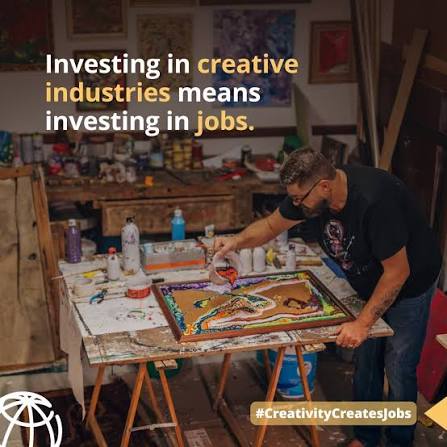
How creative industries are turning talent into jobs, businesses, and investable markets.
by Maria Galang and Catherine Ndung’u
A tailored jacket, a sports arena, and a blockbuster film may appear to have little in common. Yet each depends on extensive networks of workers, suppliers, entrepreneurs, and businesses that extend far beyond the finished product.
Creative industries generate more than $2.3 trillion in annual revenue globally, employ over 200 million people, and account for 6.2 percent of global employment. Yet in many emerging markets they remain significantly underfinanced despite their growth potential.
At the same time, the world faces a growing employment challenge. Over the next decade, 1.2 billion young people in developing countries will reach working age, with an estimated 300 million lacking clear pathways to employment. Creative industries already employ millions of young people and women globally and, in Africa alone, could contribute 20 million jobs and $200 billion in economic value by 2030.
Despite this potential, emerging markets receive less than one percent of global financing for the creative economy.
Since November 2022, IFC has committed nearly $1 billion to creative industries across emerging markets, making it the largest development finance institution investor in the sector. Its portfolio spans fashion, sports and entertainment, film, the creator economy, and immersive technology, reflecting a growing recognition that creative industries are not only cultural assets but also investable businesses capable of creating jobs and supporting economic growth.
BEHIND EVERY GARMENT IS A JOB
For Ghanaian designer Aisha Ayensu, founder of Christie Brown, every garment tells a story that extends well beyond the person wearing it.
“For every piece that we make, you have to realize the many hands that have touched the piece,” she says. “It’s not just a beautiful jacket. It is the artisans, the embroiderers, the seamstresses, the batik makers. But not just them. It is their families as well.”
Across Africa, where around 90 percent of fashion businesses are SMEs, that interconnected value chain creates opportunities in manufacturing, logistics, retail, design, and marketing.
Yet many businesses struggle to reach the scale needed to attract investment.
To help address that challenge, IFC launched the SME Fashion Champions Program, which aims to support 30 high-potential fashion, beauty, and design businesses across Africa through tailored technical assistance and, where appropriate, investment opportunities. The program identifies promising companies, assesses their business needs, co-develops growth plans, and provides support in areas such as production scaling, digital capabilities, market expansion, and supply chain management.
The initiative builds on lessons from an earlier pilot that demonstrated African creative SMEs can achieve significant commercial growth but often require strategic advice and operational support alongside financing.
For Wandia Gichuru, founder and CEO of Vivo, that combination is essential.
“Made in Africa is a key part of our mission,” she says. “We believe that you’ll create about 16 times more jobs when you produce locally.”
She also believes the sector needs greater institutional backing.
“For the longest time, people didn’t see fashion, especially fashion in Africa, as a serious place to invest. It’s not just about access to finance, but also access to knowledge, advisory, and technical skills on how to better our businesses.”
For companies such as Made For A Woman in Madagascar, which works with more than 1,000 artisans and impacts over 3,000 lives, scaling means creating opportunities that extend throughout local communities.
Made 4 A Woman Atelier, Antananarivo, Madagascar
DEVELOPING SKILLS FOR THE DIGITAL ECONOMY
The modern film industry relies on far more than actors and directors.
Visual effects artists, software engineers, animators, editors, technical directors, and digital specialists all contribute to productions that increasingly combine creativity with advanced technology.
Recognizing this convergence, IFC committed up to $75 million to DNEG, one of the world’s leading visual entertainment companies, to support the expansion of its operations in India and create more high-skilled jobs in visual effects and animation.
The financing supports technology investment, studio expansion, and workforce development while also helping increase opportunities for women in an industry where they remain underrepresented.
“With digitalization connecting developing markets’ economies to global markets, IFC’s investment in cutting-edge digital content will boost the competitiveness of the visual effects and animation sectors in India and beyond and contribute to expanding opportunities for women in a male-dominated field,” said IFC Managing Director Makhtar Diop.
DNEG employs more than 11,500 people worldwide and has worked on productions including Dune, Oppenheimer, and The Flash. Its growth demonstrates how creative industries can help emerging markets build globally competitive digital capabilities while creating skilled employment.
For countries with young and increasingly connected populations, investments in animation and visual effects represent investments in the broader digital economy.
CREATOR ECONOMY: NEW WAYS TO WORK AND EARN
That same convergence is reshaping the wider media economy. As content moves across social platforms, streaming channels and immersive environments the line between media companies and creators is becoming less distinct. For IFC, creator-focused technologies and platforms can help individual creators and small production teams produce more efficiently, reach larger audiences and monetize their work, opening new connections to local and global demand. At the same time, creative and cultural industries offer a promising pathway for youth employment.
VUZ, an immersive content platform founded by Jordanian entrepreneur Khaled Zaatarah, creates, distributes, and monetizes creator-driven sports, entertainment, and educational content in augmented reality, 360-degree video, and virtual reality. The platform reaches more than 1.2 million active users each month, with two-thirds based in emerging markets, and has exclusive immersive content partnerships with organizations including LaLiga, Serie A, and the Professional Fighters League.
IFC’s $5 million investment in VUZ is designed to help expand original content production, grow the platform’s reach across North Africa, Southeast and East Asia, and create more income opportunities for young creatives. The investment is complemented by advisory support aimed at helping more women creators build audiences, strengthen monetization, and participate in a digital media market that remains difficult for many creators to access.
“Partnering with IFC is a major milestone as we continue scaling our impact in emerging markets. This support will enable more creators across Africa and Asia to build sustainable businesses and connect with broader audiences,” said Khaled Zaatarah, Founder and CEO of VUZ.
BULDING ECONOMIC DISTRICTS AROUND ENTERTAINMENT
On match day, a stadium is much more than a place to watch a game. It becomes a gathering point for fans, families, musicians, food vendors, security staff, broadcasters, and hundreds of small businesses that keep the event running.
Across Africa, that activity represents a growing economic opportunity. The continent’s sports economy is already valued at $12 billion and could exceed $20 billion by 2035, supporting jobs not only on the field but across hospitality, tourism, retail, media, and entertainment.
“The sports and entertainment economy in Africa is booming, but we need the infrastructure to match,” says Zaria Group co-founder Masai Ujiri. “When you build the right foundation with the right partners, extraordinary things happen. These districts will generate thousands of jobs, empower local businesses, and become hubs where African culture and talent thrive.”
That vision sits behind IFC’s partnership with Zaria Group to develop sports and entertainment districts in Kigali and Nairobi. Rather than building standalone arenas, the goal is to create destinations that bring together sport, culture, business, and community while attracting private investment.
The Nairobi project alone is expected to create approximately 3,500 construction jobs, more than 1,000 permanent jobs, and tens of thousands of event-based jobs, while supporting tourism and local businesses. IFC’s planned equity investment of up to $18 million is expected to help mobilize up to $100 million in additional equity and approximately $70 million in debt financing.
For IFC Managing Director Makhtar Diop, the investment reflects the wider role creative industries can play in development.
“Africa’s creative industries are emerging as major engines of jobs, skills, and inclusion,” he says. “Sectors such as sports and entertainment already employ millions worldwide and provide accessible entry points into the formal economy, especially for young people and women.”
Zaria Court, Kigali, Rwanda
BUILDING CONDNS FOR GROWTH
Amena is a fashion designer in Freetown, Sierra Leone. When she launched Amena’s Couture, a label making contemporary Sierra Leonean clothing for men and women, what she lacked was not talent or demand. It was the business infrastructure to grow: the registration, the financial systems, the supplier connections, and the knowledge of how businesses like hers operate at scale.
She found it through the World Bank’s CreatiFi program, which paired a national creative economy diagnostic with a women-focused business accelerator. Over three months, Amena completed her formal business registration, strengthened her financial management, and traveled to the CreatiFi Lagos Exchange, where she met reliable suppliers and saw production at scale for the first time. Six months later, she had doubled her team from five to eleven employees and increased revenues by 37 percent.
Across the cohort of 24 entrepreneurs, every business formalized, 60 percent made new buyer or supplier connections, and the program created 30 direct jobs. The model is designed to be replicated. The World Bank produced an Accelerator Manual and a Diagnostic Toolkit so governments and development partners can adapt the approach across countries and creative subsectors.
CAPITAL FOLLOWS EVIDENCE
Anya started as an idea. The creative company behind Visa for Music draws 20,000 attendees and over 1,200 music industry professionals to Marrakech each year. It did not begin with investors or infrastructure. Through structured incubation support, its founders restructured their business model and built something that now competes on a continental stage. What made that possible was a market with enough structure to support it.
In Morocco, that structure required evidence that did not yet exist. IFC worked with national institutions to produce the first comprehensive assessment of the country’s cultural and creative industries. The sector employed over 116,000 people in 2023, outpacing healthcare and financial services, yet received less than 0.5 percent of all business credit. Women hold 34 percent of jobs in the sector, well above the national average, and almost no access to the financing that would let them grow.
The assessment put that picture on the table for the first time. Capital follows evidence. In Morocco, the evidence now exists.
“Behind every talent are jobs,” said Neïla Tazi, founder and Honorary President of Morocco’s Federation of Cultural and Creative Industries. “Now is the time to be bold and make it a priority.”
LOOKING AHEAD
In developed economies, creative industries contribute as much as 7.3 percent of GDP. In many emerging markets, that figure is as low as 0.5 percent. By 2030, creative industries could account for 10 percent of global GDP. As emerging markets look for new drivers of growth, sectors such as fashion, sport, music and film are showing how investment in creativity can generate employment, strengthen local businesses, and expand economic opportunity.
For IFC, the experience to date points to a clear conclusion: supporting more creators is not enough. The goal is to build the industries and markets that create jobs at scale through patient capital, technical assistance, and long-term partnerships.
Source: IFC

