



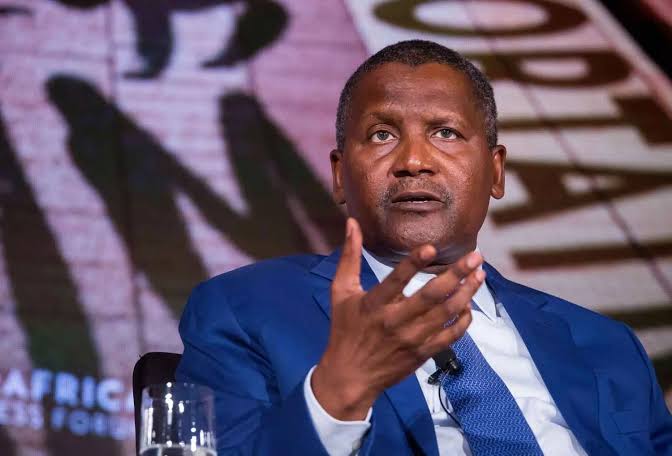
The first slot of this story by Dan D. Kunle, was published last week.
Dangote and Nigeria’s Digital Infrastructure Opportunity
Aliko Dangote’s expansion into Nigeria’s digital infrastructure space would represent a natural extension of his industrial philosophy and a strategic response to one of the country’s most binding development constraints. Nigeria’s digital economy continues to be limited by inadequate backbone fiber, insufficient data center capacity, unreliable power for mission-critical facilities, and uneven connectivity between urban and rural areas.
Dangote’s proven ability to mobilise long-term capital, integrate infrastructure across value chains, and operate at scale positions him uniquely to address these gaps through investments in carrier-neutral data centers, fiber backbone networks, energy-backed digital hubs, and satellite-supported connectivity for underserved regions. Just as his entry into cement and refining challenged Nigeria’s dependence on imports, a deliberate push into digital infrastructure could reduce the country’s reliance on offshore data hosting, lower bandwidth costs, strengthen data sovereignty, and accelerate productivity across finance, manufacturing, education, and government services.
More importantly, such an expansion would signal a shift in how Nigeria approaches digital infrastructure, not as a consumption-driven service sector, but as foundational industrial capital essential to national competitiveness and long-term economic transformation.
The Way Forward: Dangote and Africa’s Development Question
The Dangote phenomenon is ultimately about systems, not individuals. It reveals what becomes possible when capital, discipline, and long-term planning converge, and what remains elusive when institutions are weak.
Nigeria’s tragedy is not a lack of talent or resources, but the failure to build environments where industrial success is the norm rather than the exception. Until production is prioritised over exchange, institutions over improvisation, and long-term planning over short-term gain, development will remain constrained.
The way forward requires deliberate investment in education, health, agriculture, and infrastructure, alongside cohesive coordination across federal, state, and local governments. Recent subnational efforts, such as agricultural reforms in Niger State and development initiatives in Lagos State, illustrate what coordinated leadership can achieve.
Nigeria must actively encourage industrialists such as Aliko Dangote, Mike Adenuga, Femi Otedola, Samad Rabiu, Dahiru Mangal, and Professor Barth Nnaji to deepen investments in agriculture and electricity, sectors foundational to broad-based transformation.
Dangote’s story offers no miracle cure, but it offers evidence. African economies can build at scale. The constraints are institutional, not cultural. Without reform, even extraordinary successes will remain isolated.
As Nigeria and Africa approach 2026 with ambitions of a one-trillion-dollar economy by 2030, the lesson from Brazil, India, and China, and Dangote’s journey, is clear. Development is engineered, not improvised.

