



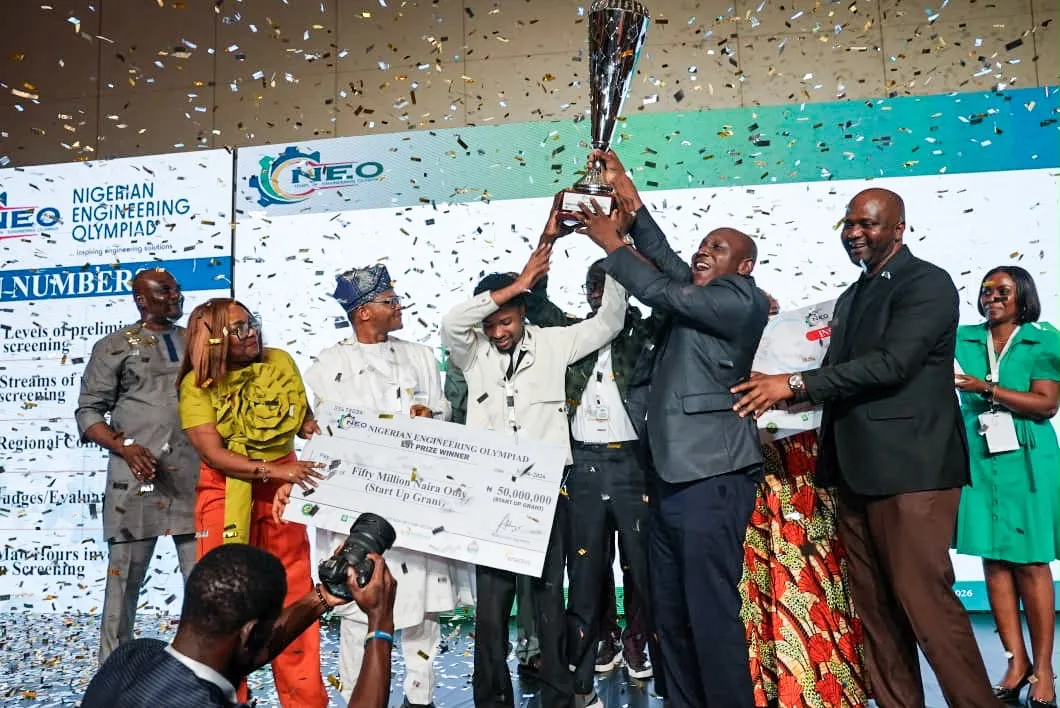
Four Nigerian universities have secured a combined ₦235 million in grants and institutional awards at the inaugural Nigerian Engineering Olympiad (NEO), a national competition aimed at accelerating engineering innovation, commercialization and industry-academia collaboration.
The competition rewarded student-led technologies addressing some of Nigeria’s most pressing challenges, including security, healthcare, agriculture and energy, while also providing long-term mentorship, business development support and access to industry partnerships.
At the grand finale held in Lagos on June 30, Modibbo Adama University of Technology (MAUT), Yola, emerged as the overall winner, receiving ₦50 million in seed funding for its innovation, Ubuntu Sapphire, a decentralized community-powered security intelligence and rapid alert platform designed for rural and underserved communities with limited internet connectivity.
The University of Ibadan (UI) finished second and received ₦30 million for Aurora Birth, a health technology solution developed to reduce neonatal deaths caused by birth asphyxia, particularly in low-resource healthcare settings.
The University of Jos claimed third place with Sentra, a solar-powered, artificial intelligence-enabled crop diagnostic device that identifies pests, plant diseases and soil nutrient deficiencies before visible symptoms appear, enabling farmers to intervene early and improve yields.
The University of Nigeria, Nsukka (UNN) placed fourth with Flameless, a modular power-generation system that converts associated natural gas into electricity to deliver affordable and reliable power for households, businesses and communities.
Beyond the ₦110 million awarded directly to the winning teams, the engineering faculties of the universities also received institutional support. MAUT was awarded a Centre of Excellence Building, while the University of Ibadan and the University of Nigeria, Nsukka received ₦75 million and ₦50 million, respectively, to strengthen engineering education, research and innovation infrastructure.
Organizers said the Olympiad was designed not only to recognize engineering excellence but also to bridge the gap between academic research and commercial application by helping promising innovations reach the market.
The maiden competition attracted 984 student participants representing 375 project teams from 80 tertiary institutions across Nigeria. Following an initial evaluation, 30 teams advanced to regional competitions held across the country’s six geopolitical zones before 12 finalists qualified for an intensive national innovation bootcamp in Lagos.
Participants received prototype development grants of ₦3 million each, alongside mentorship from engineering professionals, entrepreneurs, investors and business leaders before competing in the national finals.
Speaking at the event, Margaret Oguntola, immediate past President of the Nigerian Society of Engineers (NSE), said the initiative was created to unlock the potential of young Nigerian engineers and strengthen the country’s industrial and technological development.
She noted that the Olympiad addresses the disconnect between the country’s engineering talent and its broader industrialization ambitions by providing students with a pathway from innovation to commercialization.
Representing the NSE on the Olympiad Steering Committee, Olutosin Ogunmola described engineering as a critical driver of economic development and said the competition seeks to foster the same culture of excellence and public recognition that has helped transform other sectors of the Nigerian economy.
Michael Ajayi, Country Director of Enactus Nigeria, the programme’s implementing partner, said investing in youth-led engineering innovation is essential to building sustainable businesses, creating jobs and solving real-world challenges.
The Nigerian Content Development and Monitoring Board (NCDMB), which initiated the Olympiad, reaffirmed its commitment to identifying and supporting engineering talent in Nigerian universities.
Representing the Executive Secretary of the NCDMB, Felix Omatsola Ogbe, officials urged stakeholders to ensure that the winning innovations progress beyond the competition and are successfully commercialized to deliver economic and social impact.
Funding partner Renaissance Africa Energy Company Limited announced that prototype development grants for future editions of the Olympiad will increase from ₦3 million to ₦5 million per shortlisted team, reflecting growing confidence in the programme.
Another sponsor, FIRST Exploration & Petroleum Development Company (FIRST E&P), said initiatives such as the Olympiad can strengthen science, technology, engineering and mathematics (STEM) education while helping reduce the country’s engineering talent drain.
Representatives of the National Agency for Science and Engineering Infrastructure (NASENI) also commended the competition, describing it as an important platform for identifying future engineering leaders capable of driving Nigeria’s industrial transformation.
The inaugural Olympiad showcased innovations across healthcare, renewable energy, agriculture, security, infrastructure, manufacturing and industrial technology, underscoring the growing role of university-led research in addressing national development priorities.
Organizers said the competition will continue to focus on supporting commercially viable engineering solutions capable of attracting investment, creating jobs and contributing to Nigeria’s innovation-driven economy.

