



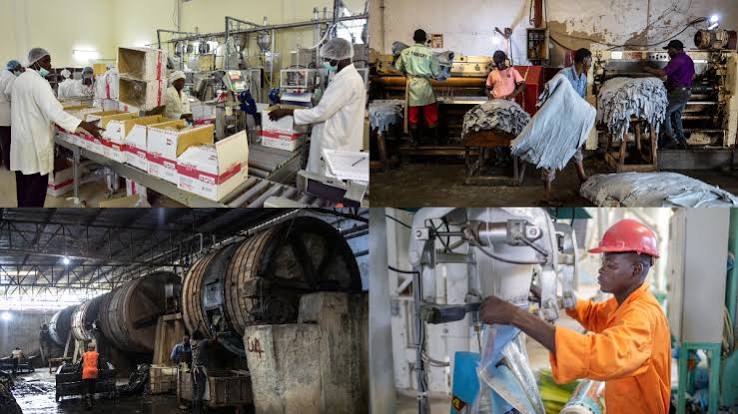
The Manufacturers Association of Nigeria (MAN), has cried out against the financial constraint militating manufacturers in Nigeria, find it uncomfortable and want a reversal of the situation.
The Association recently came up with a chart which portrays concerning evidence of the severe financial constraint in question.
According to the data, commercial bank credit allocation to manufacturing contracted by ₦1.92 trillion from ₦8.53 trillion in December 2024 to ₦6.61 trillion in December 2025. This represents a significant year-on-year contraction of -22.5%, MAN considers “particularly disturbing, given that manufacturing recorded one of the largest credit contractions among the top sectors, surpassed only by the General Services sector at -25%”.
MAN argues:
- This steep decline leaves manufacturing lagging far behind the extractive Oil & Gas Industry (₦10.59 trillion) and a booming Finance sector (₦9.24 trillion), demonstrating a systemic preference for speculative and rent-seeking activities over tangible productivity.
• The 22.5% credit squeeze of ₦1.92 trillion from the manufacturing sector stands in unflattering contrast to contemporary global peers in 2025. For instance, India’s bank credit to industry grew by a robust 9.6% year-on-year by late 2025 as part of a deliberate 15% industrial credit expansion, while Vietnam aggressively projected a 19% to 20% credit growth target for 2025 to intentionally fuel its processing and manufacturing engines.
• Clearly, the Nigerian manufacturing sector cannot thrive without sustainable and growing financial foundations. The reduction in credit access could further limit capacity utilization, stall technological upgrades and hinder job creation. For the wider economy, reducing financial support to manufacturing could slow down vital diversification efforts, leaving the nation more vulnerable to external commodity shocks and supply-driven inflation.
MAN lists major Factors Responsible for Lower Access to Credit as follow:
The Prohibitive Interest Rates;
Elevated Cash Reserve Requirements & Risk Aversion of Commercial Banks;
Non-implementation of the ₦1 Trillion Manufacturing Stabilization Plan;
The CBN’s Policy Shift to Halt Direct Development Financing.
To drive home its argument, MAN lists the critical implications of the Manufacturing Credit Contraction.
Said MAN: “The steep -22.5% year-on-year contraction in commercial credit allocation to manufacturing creates severe bottlenecks across the entire sector. Based on financial data and operational insights from the field, here are the five primary macroeconomic implications of this credit squeeze:
Suppression of Manufacturing Capacity Utilization;
Structural Stagnation of Sectoral Contribution to National GDP;
Escalation of Workforce Downsizing and Structural Unemployment;
Exacerbation of Supply-Side Inflation and Foreign Exchange (FX) Strain;
Possibly Paralysis of the 2025 Nigeria Industrial Policy (NIP).
MAN argues it has consistently maintained that the current funding framework is unfit for purpose. It notes that according to the Manufacturing State of Affairs 2025 report, without a dedicated, shielded financial mechanism, the sector cannot operate competitively. MAN therefore that key industry demands to rectify the funding failure include:
• Further reduce the benchmark interest rate by at least 200–300 basis points over the next two quarters to improve credit affordability for manufacturers,
• Reduce the Cash Reserve Ratio (CRR) for commercial banks that allocate at least 40% of their lending portfolio to manufacturers at single-digit interest rates.
• Increase the capital base of the Bank of Industry (BOI) to meet direct credit demands, bypassing the stringent commercial bank PFIs where possible.
• Expand the Bank of Industry (BoI) intervention fund to allow manufacturers to refinance high-interest commercial bank loans at a fixed 7–9% rate for a minimum of 10 years.
• Operationalize a 50% government-backed guarantee for commercial bank loans extended to Small and Medium Industries (SMIs) involved in value-added processing.
• Communicate the implementation status and enforce the release of the ₦1 Trillion Manufacturing Stabilization Fund.
• Transfer the management of the Manufacturing Stabilization Fund to the Bank of Industry (BOI) with a mandate for a 9% interest rate cap and a strict 7-day processing timeline for verified manufacturers.
In summation, in its robust argument signed by its DG Segun Ajayi-Kadir, it states:
- The persistent financial starvation of Nigerian manufacturing stems not from an absolute scarcity of national capital, but from a fundamental breakdown in policy alignment and distribution architecture. Deploying developmental funds through flawed commercial banking channels that prioritize short-term profitability and rigid collateral over long-term industrial viability inherently neutralizes their economic intent.
• In an environment destabilized by a high rate of foreign exchange and volatility (though less severe) and commercial lending rates soaring past 30%, these interventions do not catalyse real-sector growth. They have shown that allocating liquidity through a flawed mechanism does not help industrialization.
• To reverse this structural stagnation and unlock the sector’s potential, Nigeria must radically decouple developmental credit from the risk-averse restrictions of standard commercial banking frameworks.
• Outsourcing the financial survival of the manufacturing sector to undercapitalized development banks while the monetary system locks its primary liquidity vault is a structural mismatch that guarantees our productive frontline remains permanently starved of capital.
• Crucially, we earnestly implore the Central Bank to pivot away from measures that suffocate the manufacturing sector with affordable credit, while attempting to cure structural inflation. This will ensure that we do not inadvertently deepen the domestic supply-side deficits that drive prices upward in the first place.
• Government should demonstrate its commitment to economic diversification by establishing independent, transparently managed transmission channels capable of delivering genuine, single-digit interest rates directly to domestic manufacturers.
•. The government should conduct an urgent manufacturing sector audit to ascertain the impact of the major reforms under this administration on the sector.
• Until policy promises are structurally insulated from hostile commercial loan criteria and translated into accessible capital, Nigeria’s ambition to transform into a competitive manufacturing powerhouse will remain permanently stalled.

