



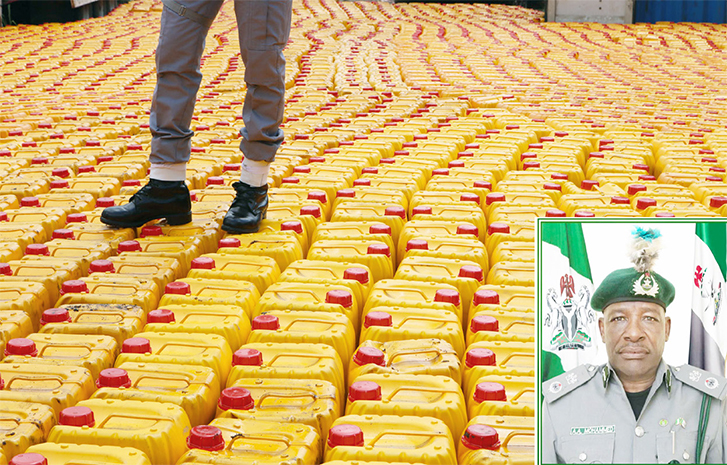
Edible oil stakeholders in Nigeria gathered in Lagos recently to protest the unwholesome activities of edible oil smugglers. These economic saboteurs constitute a pain in the neck of local vegetable oil business persons who are running legitimate businesses whom regulators put under strict check.
Siaka MOMOH who was at the august event, brings you his report
Graham Hefer, MD Okomu Oil Palm Company Plc
Under Nigeria’s current policy framework, crude palm oil can be imported, but only under certain conditions. If it is imported from outside the ECOWAS region, it must attract the appropriate duties and levies. If it comes from ECOWAS countries, then the importer must provide a certificate of origin and pay the ECOWAS Trade Liberalisation Scheme (ETLS) levy, which is about 5 percent. However, refined palm oil and related vegetable oils are completely banned from importation.
So the policy is actually quite clear. The challenge is enforcement. What we are seeing in the market today is that some traders bring in products and mislabel them. They claim the product is crude palm oil, but in reality it is processed palm olein or other refined derivatives that should not be entering the country under current regulations.
In addition, many of these imports are not paying the required duties and levies. That means the government is losing revenue, while local producers are forced to compete with products that enter the market at artificially lower prices.
One of the tactics used is to claim the product is “crude palm olein,” which is often labelled with the same acronym, CPO, as crude palm oil. In reality, there is no such thing as crude palm olein; it is already a processed product. That is one way some operators circumvent the regulations.
The bigger problem is that a significant amount of this oil is simply being smuggled through porous land borders. Even if someone wants to pay duties, they often do not. The reality is that Nigeria’s borders are currently very porous, and smuggling affects almost every commodity, not just palm oil. For producers like us, it creates an extremely difficult environment. We are operating within the law, paying taxes and complying with regulatory standards, while illegal products enter the market and distort prices. That is not a sustainable situation for any industry.
When products enter the country illegally or under questionable classifications, they often bypass the regulatory agencies responsible for quality control.
For example, our products are routinely tested and certified by regulators to ensure they meet required food safety and quality standards. But when products are smuggled or misdeclared at entry points, they may not pass through those checks.
So beyond the economic impact, there is also a potential consumer safety issue because authorities cannot verify the quality of those products. If the government engaged more with stakeholders in the sector before introducing policies like waivers or allowing large volumes of imports, we could help design solutions that protect both consumers and local industries.
Right now, however, what we are seeing is essentially unfettered importation, which could damage not only the palm oil industry but other agricultural sectors as well. You can already see similar complaints coming from rice millers, tomato producers, and other commodity groups.
Anoop Sharma, CEO PZ Wilmar
Nigeria loses $2 billion monthly to vegetable oil smuggling. The loss is from estimated 18000 tonnes of plastic containers of vegetable oil being smuggled into the country. When you multiply this number by $1400 per tonne, the value of palm oil in the international market you will get this value.
Every month, about 18,000 jerry cans of vegetable oil are smuggled into Nigeria through its various borders and the cans are about $1300 per tonne. But when you multiply this by $1400 being the acceptable international price, and multiply that by 18000 tonnes of jerry cans every month by 12 months, this gives you $2 billion estimate per year that Nigeria economy is losing.
The price of palm oil in the international market has also dropped slightly to about $1050 which is about N1.6 million now. Again when you compare cost of production in smuggling countries and cost of production in Nigeria, cost of production in Nigeria is higher. So the smuggler has an advantage over Nigerian producers. He makes more margin.
.
Fatai Afolabi, MD Foremost Development Services Limited (sustainability consultants)
Vegetable and edible oil producers are under pressure as imported vegetable oil brands reduce demand for locally processed brands. Cocoa farmers continue to battle price volatility in international markets while shouldering rising domestic costs of labour and farm maintenance. Because tree crops like oil palm and cocoa are crops of long gestation periods, they thus require long-term investment and patience. Sudden market disruptions are especially damaging, undermining investor confidence and discouraging new investment. Downstream, the effects extend to agro-processing and value addition. Soybean farmers supplying processors for vegetable oil production are experiencing reduced demand and lower prices. Small- and Medium-Scale processors are squeezed between cheaper imports and the high cost of energy, packaging, and logistics. This threatens not only farm incomes but also rural employment and agro-industrial development. These developments raise a critical question about food security. Food security is not solely about ensuring that food is available and affordable today. It is also about safeguarding the capacity of local producers to continue producing tomorrow. If sustained losses force farmers out of production, Nigeria risks increasing its dependence on imports, exposing itself to global supply shocks, foreign exchange pressures, and long-term vulnerability in its food system. Other countries offer valuable lessons on how to balance consumer protection with farmer sustainability. In India, for example, food imports are sometimes used strategically during shortages, but they are carefully timed and complemented by strong domestic support systems.
Oil palm, a cornerstone of Nigeria’s agricultural economy and a vital raw material across multiple industries, has the potential to generate over N20 trillion in annual revenue for the country, if the government at all levels collaborate effectively with stakeholders and smallholder farmers to strengthen the value chain.
Alphonso Inyang, President of National Palm Produce Association of Nigeria (NPPAN)
I would like to look at the oil palm sector, mostly as it concerns the smallholders, who produce quite a large amount of what we currently produce in the country. The general implications of recent government policy and programmes or what the government calls intervention in the agricultural sector, have resulted largely in the impoverishment of primary producers of agricultural products. And it cuts across oils, cereals, and a lot of them. Currently, we are trading at a price that is 50 per cent less than what it was just less than two months ago. And we are still in the lean season for oil palm.
Currently, at the price we are selling palm oil in this country, we are selling at less than production price. And this is not good enough for smallholder farmers who depend on this for school fees, who depend on this for medicine, who depend on this for the general economic well-being of their households and their communities.
Nigeria is a major market for our neighbours because of our population, because of the size of our economy, and because of the level of our industrial development. Currently, our importation bill hovers around maybe $600 million every year. That’s a lot of money. That’s what we use to create jobs in Malaysia. We create jobs in Indonesia. We create jobs in Ghana, in Ivory Coast and in Benin Republic. These countries bring in oil at no duties or very minimal duties and now send them to Nigeria at a cheaper rate. And it suppresses local production because they arrive quite cheap.
The government needs to do more to check all these that come in. The government is losing revenue, farmers are being suppressed through an influx of oil that comes in at very cheap prices, thereby forcing local producers to sell at prices determined by smuggled products. So, the government needs to do more to protect primary producers of palm oil in other parts of the country to remain in business. It’s affecting our business. And we cannot do much about it.
We have been talking about this for years now. But if you look at what comes into this country from the land and the sea borders, we have more than 300 entry points for palm oil from Akwa Ibom State alone. Between Mbu, Oron, and Owan local government areas, we have more than over 300 entry points for palm oil that enters through the waterways. They offload them every night and morning. And at the end of the day, we keep seeing lorries and trailers leaving Oron, heading to every other part of the country but who is taking note of this? The reason this keeps happening is that some of our land and sea borders are the major problem.
We want this government to look at the oil palm sector as a big sector. The oil palm is known in Malaysia and Indonesia as the tree of life, but we are yet to see it that way in Nigeria. The government does not see oil palm as a commodity that can be used to fight poverty, and all manner of vices and empower rural households to be able to produce both for themselves and for the general economy. So the government really needs to look at this sector as a sector that needs to be invested in. We should stop helping Malaysia and Indonesia to tell their story.
Ghana that is producing so little oil palm, in this year alone, has budgeted $100 million to be invested in oil palm development alone. And this is being managed as a programme under the Tree Crop Development Authority of Ghana to be implemented by the Ministry of Finance as a special programme. If you go to the Federal Ministry of Agriculture and ask the desk officer, “what is the budget for oil palm this year?” He will tell you, “Oga don’t ask me that kind of question because the one they approved before, they have not released it?”
The government needs to lead the way. As an association, more often than not, we can only talk, but without the partnership, collaboration and encouragement of governments there isn’t much we can do. When I talk about governments, it’s not just the national government. The subnational governments too.
Emmanuel Ibru, Chairman of the Plantation Owners’ Forum of Nigeria (POFON)
The industry witnessed a sharp influx of imported vegetable oil toward the end of 2025. This was at a time when local producers were already grappling with high production costs. The situation has had severe ripple effects on vegetable oil manufacturers and palm oil producers. Palm oil remain a critical input in vegetable oil production. Earlier policy interventions, particularly during the President Olusegun Obasanjo administration, helped stabilize the sector through the imposition of duties on palm oil imports and a ban on refined vegetable oil imports. Since that time, billions of dollars had been invested by indigenous companies across plantations, processing and logistics, investments have been under threat due to cheap imports. When you are pushing down food prices, what is the point if the people meant to benefit no longer have jobs or income?
Christopher Uwala, President of the Soyabean Association of Nigeria
Unchecked imports and poor data has distorted the market and discouraged farmers. If Nigeria consumes 1.6 million tonnes and produces 1.2 million, only 400,000 tonnes should be imported. But there are no reliable statistics, and people import far beyond shortfalls. Falling prices and lack of access to equipment and quality inputs are pushing farmers out of production, with long-term implications on health and food security.
Okey Ikoro Chairman of the Vegetable and Edible Oil Producers Association of Nigeria (VEOPAN)
Frequent policy changes are destabilising an industry with long gestation periods and high capital requirements. The issue of smuggling further complicates matters as unbranded vegetable oil often transported in yellow jerry cans, has become common in markets across the country. Aside from economic damage, the influx poses quality and public health risks, as such products fall outside regulatory oversight. Plantations take years to mature. You cannot encourage investors to borrow and invest, then suddenly reduce tariffs to allow cheap imports. It will lead to debt, unemployment and increased foreign exchange pressure.
Regional trade agreements such as the African Continental Free Trade Area (AfCFTA) allows countries to protect sensitive and strategic products, including food commodities. Government should retain edible oil on the import prohibition list, strengthen border controls, enforce existing policies, and introduce targeted incentives and intervention funds to support local production.

