



This article is part of:World Economic Forum Annual Meeting
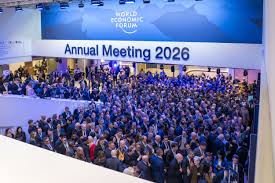
- The World Economic Forum’s Annual Meeting 2026 has wrapped up in Davos, Switzerland.
- A record number of political leaders came together under the overarching theme ‘A Spirit of Dialogue’.
- The week exposed the tension between systemic fault lines and geopolitical noise – and raised many urgent questions.
- Here are four takeaways from the 2026 Annual Meeting in Davos.
More than a century ago, the Austrian poet Rainer Maria Rilke in his letters to a young poet urged them to “live the questions now”, to embrace uncertainty as the necessary condition for eventual answers.
Or, as Canadian Prime Minister Mark Carney put it in Davos this week: “We actively take on the world as it is, not wait around for the world we wish to be.”
Carney was just one of more than 60 heads of state and a record 400+ political leaders and 830 CEOs and Chairs who came to the Magic Mountain under the theme ‘A Spirit of Dialogue’.
It was a week where the World Economic Forum’s Annual Meeting facilitated the making of history, not by providing the answers, but by creating the conditions under which deeply polarized actors could begin to live the most consequential questions of our age.
Those questions themselves became sharper and the pathways, if not yet clear, at least visible.
Middle powers found their voice, dialogue reasserted itself as necessity, and the shape of a new geostrategic dynamic began to emerge.
Here are four ways Davos 2026 clarified what’s at stake.
1. New deals, new dynamics
There was a tense moment on Wednesday, when news landed that Air Force One had turned back, delaying US President Donald Trump’s arrival in Davos. But his Special Address to a packed Congress Hall was delivered on schedule.
He spoke at length about wanting to see a “strong Europe”: “We believe deeply in the bonds we share with Europe as a civilization. I want to see it do great. That’s why issues like energy, trade, immigration and economic growth must be central concerns to anyone who wants to see a strong and united West.”
And he changed his stance on Greenland, saying “we probably won’t get anything unless I decide to use excessive strength and force, where we would be, frankly, unstoppable… But I won’t do that”.
He acknowledged it was “probably the biggest statement I made, because people thought I would use force”.
It’s clear there’s a rupture between the US and Europe and it was a recurrent topic of conversation throughout the week, with leaders offering differing thoughts on whether it was irreparable.
We might be just at the beginning of a “once-in-century” breakdown of the global order, said Gita Gopinath, Harvard Professor of Economics and the former First Deputy Managing Director of the IMF.
“I think what’s long-lasting is the complete breakdown of trust between the US and Europe.”
“
The US-Europe alliance was a critical part of the global economic order – and the fact that it is being ruptured is very consequential.
”
— Gita Gopinath, Professor of Economics, Harvard
“Europe is looking for strategic autonomy. They are figuring out how to rely… on their own internal economy, their own internal security. So there’s no going back on that, regardless of how this week goes.”
“Nostalgia is part of our human story, but nostalgia will not bring back the old order and playing for time and hoping for things to revert soon will not fix the structural dependencies we have,” said European Commission President Ursula von der Leyen.
“If this change is permanent, then Europe must change permanently too. It is time to seize this opportunity and build a new independent Europe.”
Carney sounded a note of optimism and took the lead on bold statements of middle-power defiance that defined the week.
“We know the old order is not coming back. We shouldn’t mourn it… but we believe that from the fracture, we can build something bigger, better, stronger, more just.
“This is not niave multilateralism… It’s building coalitions that work, issue by issue with partners who share enough common ground to act together.”
“
The middle powers must act together because if we’re not at the table, we’re on the menu.
”
— Mark Carney, Prime Minister of Canada
Speaking on Thursday morning, Gavin Newsom, Governor of California and a US presidential hopeful, said transatlantic relations were “dormant not dead”.
And the view from China? “Tariffs and trade wars have no winners,” said Vice-Premier He Lifeng.
Meanwhile, negotiations were taking place, with the green shoots of new deals sprouting.
European Commission President Ursula von der Leyen announced in her Special Address the EU and India were “on the cusp” of an historic free trade agreement with India.
“
Some call it ‘the mother of all deals’. One that would create a market of 2 billion people.
”
— Ursula von der Leyen, European Commission President
And the UK’s Chancellor Rachel Reeves said she’d secured deals worth more than $2 billion in private investment.
There was a new deal for actor Matt Damon’s Water.org charity – he announced the Get Blue initiative, which partners with corporations to help scale up their work. Gap, Amazon, Starbucks and Ecolab are already on board.
2. A reckoning for humanity
Before the Annual Meeting began, the Forum published the Global Risks Report 2026. Extreme weather events dropped from second down to fourth place in the ranking this year – not because they are any less urgent a risk, but because geoeconomic fragmentation and societal polarization have become more pressing.
Global risks over the short and long-term.Image: World Economic Forum
“We live in a world of more frequent, exogenous shocks,” said Kristalina Georgieva, Managing Director of the IMF, and they will “continue to come”.
Accept our marketing cookies to access this content.
These cookies are currently disabled in your browser.
Every year, the Annual Meeting’s penultimate session on Friday is the Global Economic Outlook, where leaders explain where they see the economy heading in the coming year.
Here Georgieva expounded on her theme of facing facts and accepting how things are: “We need to look at the world as it is changing… We are not in Kansas anymore.”
Director-General of the World Trade Organization Dr Ngozi Okonjo-Iweala echoed the view, offering her advice for business leaders and policymakers amidst uncertainty.
“If I was running a country, I would be trying to strengthen myself and my region and build resilience… Maybe we’ll have a slightly steadier state for the future, but I don’t believe we’re going back.”
Accept our marketing cookies to access this content.
These cookies are currently disabled in your browser.
We live in a world of noise – and as speakers proved throughout the sessions, the noise exists from the macro level right down to the individual.
In the business of solving global problems, crises accelerate when you’re putting out fires.
Christine Lagarde warned that “we are heading for real trouble” if we don’t pay attention to the distribution of wealth and the disparity that is getting “deeper and bigger”. She urged leaders to think very carefully about the people – and “distinguish the signal from the noise” in terms of what the numbers show.

