



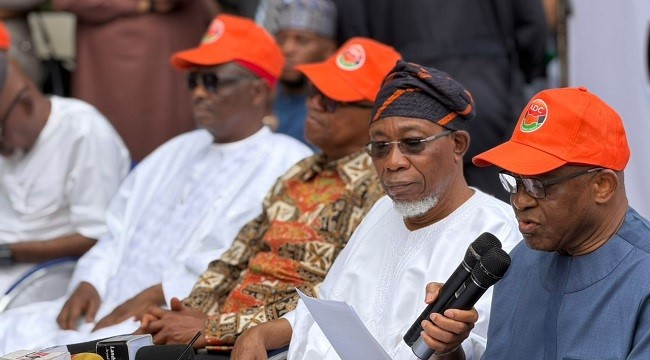
The African Democratic Congress (ADC) has pushed ahead with its nationwide congresses despite objections from the Independent National Electoral Commission (INEC) and mounting internal divisions, resulting in a patchwork of outcomes across states.
While the exercise proceeded smoothly in some areas, others witnessed disruptions, postponements, and legal interventions, underscoring the deepening leadership crisis within the opposition party.
The situation is further complicated by pending court decisions that could reshape the party’s leadership structure. Justice Musa Liman of the Federal High Court in Abuja has fixed April 13 for judgment in a suit filed by Hon. Leke Abejide, challenging the legitimacy of the Senator David Mark-led leadership. In a related matter, Justice Emeka Nwite has scheduled April 14 for hearing in another suit filed by Hon. Nafiu Bala Gombe on the same issue.
Despite INEC’s decision last week to withdraw recognition of David Mark and Rauf Aregbesola as the party’s national chairman and secretary, the ADC leadership has insisted on proceeding with its planned activities. The party has accused the electoral body of partisanship and overreach, maintaining that it fulfilled its legal obligation by notifying INEC of its congresses.
ADC National Publicity Secretary, Bolaji Abdullahi, confirmed that the party’s national convention will hold on April 14. As part of preparations, a 22-member National Convention Central Coordination Committee has been inaugurated, chaired by former Cross River State Governor, Liyel Imoke, with former Sokoto State Governor, Aminu Waziri Tambuwal, serving as vice chairman.
Across the country, the conduct of congresses has reflected the party’s fractured state.
In Ebonyi State, the exercise was conducted across all local government areas, wards, and polling units, with party officials promising transparency through consensus or direct primaries. Kano State adopted a consensus approach to avoid internal disputes, while Kogi State successfully held its local government congress in Lokoja, electing new executives.
However, divisions were more evident elsewhere. In Oyo State, rival factions scheduled parallel congresses, even as both camps proceeded with separate leadership structures. Similarly, in Anambra State, party members defied a directive by the state chairman to suspend the exercise, insisting the congresses would go ahead.
Legal and administrative setbacks also emerged in several states. A High Court in Katsina ordered the suspension of all ADC activities pending the determination of a substantive suit. In Ondo, the party complied with INEC’s directive to halt its congresses, citing respect for due process.
Enugu State’s congresses failed to hold due to conflicting committee appointments, highlighting organisational disarray at the national level. In Kwara, protests by aggrieved members disrupted proceedings, reportedly linked to the leadership tussle and the return of former party members.
Meanwhile, Kaduna, Rivers, Imo, and Taraba states recorded varying degrees of progress, with congresses either completed or scheduled, largely through consensus arrangements aimed at maintaining unity.
Despite the challenges, the Mark-led leadership has remained defiant, vowing to proceed with its national convention and broader restructuring plans. The party has also called for the resignation of INEC’s leadership, alleging actions aimed at undermining opposition parties and consolidating a one-party state.
At the heart of the dispute are legal questions over the legitimacy of the current leadership and INEC’s authority in interpreting court orders—issues that the courts are expected to clarify in the coming days.
Until then, the ADC’s congresses continue amid uncertainty, reflecting a party struggling to balance internal cohesion with external regulatory pressure ahead of the 2027 general elections.

