



Where does AfCFTA stand now? The African Continental Free Trade Area (AfCFTA) has moved into a gradual operational phase. By early-2026, most legal negotiations are substantially completed; the continental focus has shifted to actual trading systems, payment settlement, logistics corridors, and industrial participation.
| Dimension | Status (2026) |
| Political adoption | ✅ Achieved |
| Legal framework | ✅ Mostly complete |
| Payment integration | 🟡 Accelerating |
| Customs harmonisation | 🟡 Partial |
| Private-sector utilisation | 🟠 Early stage |
| Regional value chains | 🔄 Emerging |
AfCFTA currently consists of three Protocols
- Phase one negotiation protocols – covers “Trade in Goods, Trade in Services, and Dispute Settlement”, is available below.
- Phase two negotiation protocols – “Investment, Competition Policy, and Intellectual Property Rights”, also available.
- Third phase of negotiations – cover Protocols on “Digital Trade and Women and Youth in Trade”
AfCFTA Participation vs Implementation
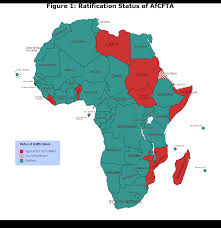
- Nearly every African Union member state has signed AfCFTA, and most (49) have ratified, establishing a legal basis for continental trade.
- Remaining Pending Ratifications – Benin, Libya, South Sudan, Somalia not yet ratified; Sudan approved but not yet deposited.
- Fully operationalised trade is progressing more slowly, with about two dozen countries actively trading under AfCFTA preferences. This shows that signing and ratifying are necessary but not sufficient for routine trade flows.
Guided Trade Initiative (GTI) Usage
- GTI began with about 7 countries and has expanded significantly, with dozens of states now participating in verified AfCFTA shipments.
- Rather than “open trade everywhere at once,” AfCFTA is being phased in through structured pilots under the Guided Trade Initiative (GTI).
- Only selected sectors and states are currently trading under AfCFTA terms through GTI.
- Most African manufacturers have not yet fully operationalised AfCFTA preference usage due to documentation, rules-of-origin, and customs coordination barriers.
Implementation Gaps
- Legal ratification and domestic alignment have outpaced actual customs application and verified trade usage.
- Many countries are still aligning tariff schedules, rules-of-origin enforcement, and border procedures with AfCFTA protocols.
Tariff Domestication Matters
- For preferences to be realised in practice, countries must complete and domesticate their tariff concession schedules.
- To date, 25 states have completed this step, enabling eligible exporters to access preferential tariffs.
PAPSS — A Growing Commercial Enabler
- PAPSS now connects around 18 African countries and over 150 banks, enabling local-currency cross-border payments and expanding rapidly.
- Policy support is accelerating adoption. For example,the Central Bank of Nigeria streamlined KYC rules for SMEs; other active central banks include Algeria, Kenya, Ghana, Tunisia, Egypt, and Morocco.
- PAPSS Recent Membership Growth: Morocco became 17th member; Algeria now the 18th, demonstrating expanding regional footprint.
Strategic Implications for Manufacturers
a. Production and Trade Competitiveness
- Manufacturers must align production capabilities with RoO requirements to benefit from tariff preferences.
- Reliance on PAPSS for settlement should be factored into export financing and currency risk strategies.
b. Logistics and Border Systems
- The biggest remaining barriers to implementation are non‑tariff: customs coordination, documentation, logistics, and trade facilitation.
- Priority investments in digital certificates of origin and pre‑arrival processing will materially reduce export lead times.
c. Policy Coordination
- Governments need to accelerate domestic legal alignment (tariff schedules, customs codes) with AfCFTA instruments.
- Cross-ministerial coordination between finance, industry, and trade ministries is essential to harmonise tariff application, RoO enforcement, and payment systems.
d. SMIs and Exporters Readiness
- Manufacturers should build compliance capacity for AfCFTA documentation and adopt PAPSS‑enabled payment processes to reduce settlement times and FX costs.
- Targeted export readiness programmes should prioritise GTI corridors and logistics connectivity.
Do We Need a Second-Generation of SEZs Model?
Africa did not adopt Special Economic Zones (SEZs) by accident. These instruments emerged from necessity. The logic was compelling – if the wider economy could not yet guarantee infrastructure reliability, customs efficiency, or regulatory speed, a controlled environment could. For many years, this approach made sense. In countries such as Ethiopia, Kenya, Morocco, Egypt, and Nigeria, zones became visible symbols of industrial ambition. Africa now hosts more than 200 SEZs [1]. Regionally, SEZ development is unevenly distributed.
North Africa accounts for approximately 29% of the continent’s SEZs, followed by East Africa (26%), West Africa (24%), Southern Africa (15%), and Central Africa (6%). This distribution reflects stronger institutional maturity and earlier adoption of SEZ frameworks in North and East Africa relative to other regions. At the country level, Nigeria and Morocco host the highest number of operational SEZs. Other major SEZ hosts include Egypt, Ethiopia, and Kenya. Although SEZ frameworks now exist in 47 of Africa’s 54 countries[2], operational depth and industrial clustering remain concentrated in a relatively small number of leading economies.
In most cases, the governance structures of Africa’s SEZs are predominantly hybrid; approximately 53% operate under public–private partnerships, 38% remain publicly managed, and only 9% are fully private. SEZs have been central to Africa’s industrial policy toolkit for more than three decades, offering tax incentives, streamlined regulations, and concentrated infrastructure to attract investment.

